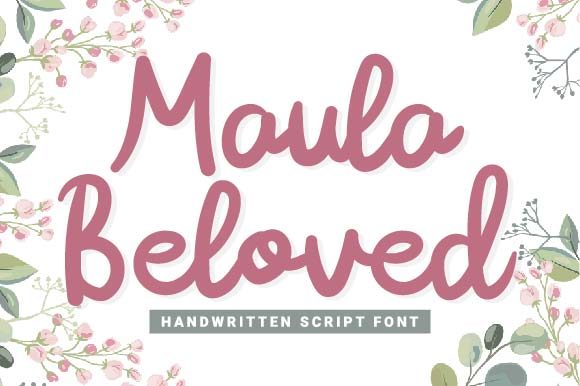
Evaluating Maula Beloved: A Practical Guide to Choosing the Right Handwritten Font
In the vast landscape of typography, finding a handwritten font that strikes the perfect balance between personality and legibility is often a challenge for designers and content creators. Maula Beloved emerges as a distinct option in this category, characterized by its sweet, flowing aesthetic that mimics the natural rhythm of a paintbrush. Unlike many digital scripts that feel rigid or overly uniform, this typeface captures the organic variance of human handwriting, making it a potentially valuable asset for projects requiring a personal touch. However, like any design tool, it is not a universal solution. Understanding where Maula Beloved fits within your creative workflow requires a clear evaluation of its stylistic traits, practical applications, and limitations compared to other script styles.
Defining the Aesthetic and Technical Profile
At its core, Maula Beloved is designed to replicate the fluidity of brush lettering. The strokes vary in thickness, simulating the pressure changes one would apply when using a real brush pen on textured paper. This "paint brushed" quality gives the font a dynamic appearance, where upstrokes are typically thinner and downstrokes carry more weight. The term "sweet" in its description refers to the rounded terminals and the gentle curvature of the letters, which avoid sharp angles or aggressive serifs. This makes the overall tone of the typography warm, inviting, and approachable.
From a technical standpoint, the flow of Maula Beloved is one of its defining features. Many handwritten fonts suffer from disjointed connections between letters, breaking the illusion of continuous writing. Maula Beloved addresses this by carefully crafting ligatures and alternate characters that allow words to connect naturally. For a designer, this means less time spent manually adjusting kerning or swapping out glyphs to achieve a cohesive look. The font's structure supports a reading experience that feels uninterrupted, which is crucial for maintaining engagement in longer headlines or short paragraphs.
Comparative Analysis: Where It Stands Among Script Fonts
When evaluating Maula Beloved against the broader spectrum of handwritten and script fonts, several distinctions become apparent. The market is generally divided into formal scripts, casual scripts, and brush scripts. Maula Beloved sits firmly in the casual brush script category, but with a specific emphasis on elegance rather than ruggedness.
Compared to formal calligraphy fonts, which often feature high contrast and intricate flourishes suitable for wedding invitations or luxury branding, Maula Beloved is more grounded. It lacks the extreme embellishments that can sometimes hinder readability at smaller sizes. This makes it a more versatile choice for modern branding, social media graphics, and packaging where clarity is just as important as style.
On the other hand, when compared to rough marker or chalkboard styles, Maula Beloved offers a cleaner, more polished finish. Rougher fonts often rely on texture and irregularity to convey a raw, authentic vibe. While effective for certain niches like craft breweries or artisanal bakeries, those styles can appear messy if not used carefully. Maula Beloved provides the authenticity of handwriting without the visual noise, offering a "cleaner" alternative that still retains a human feel. This positions it well for industries that want to appear friendly and accessible but also professional, such as wellness brands, lifestyle blogs, or boutique retail.
Ideal Use Cases and Strategic Applications
Determining whether Maula Beloved is the right choice for a project depends heavily on the intended message and the medium of delivery. Its strengths lie in contexts where emotional connection and warmth are priorities.
- Branding and Logos: For businesses aiming to project a personal, handmade, or caring image, this font serves as an excellent logo candidate. It works particularly well for florists, cafes, skincare lines, and family-oriented services.
- Packaging Design: The flowing nature of the font draws the eye across a package label. It can highlight product names or key selling points like "organic" or "hand-crafted" effectively, distinguishing the product from competitors using standard sans-serif typefaces.
- Social Media and Digital Content: In an era of digital fatigue, content that feels human stands out. Maula Beloved is highly effective for Instagram stories, Pinterest pins, and YouTube thumbnails where a quick, emotional hook is necessary.
- Greeting Cards and Stationery: Given its "sweet" descriptor, it is naturally suited for celebratory or sentimental contexts, such as birthday cards, thank-you notes, and event invitations.
The font's ability to elevate a creation comes from its capacity to soften the visual tone of a design. When paired with a clean, geometric sans-serif for body text, Maula Beloved creates a balanced hierarchy that guides the reader's attention without overwhelming them.
Limitations and Decision Factors
While Maula Beloved offers significant aesthetic benefits, it is not without limitations. A critical factor in font selection is legibility, especially across different devices and sizes. Brush scripts, by their nature, can lose definition when scaled down. If your project requires small print, such as legal disclaimers, ingredient lists, or dense body copy, Maula Beloved may not be the appropriate tool. In these scenarios, a simple sans-serif or serif font is a safer alternative to ensure accessibility and readability.
Another consideration is the context of the brand voice. If a company aims to project authority, technological sophistication, or corporate stability, a flowing handwritten font might undermine that message. For example, a law firm, a financial institution, or a tech startup focusing on data security would likely find Maula Beloved too informal. In these cases, the font's "sweet" and "flowing" characteristics could be perceived as lacking seriousness or precision.
Furthermore, designers must consider the saturation of the style. Handwritten brush fonts have been popular for over a decade. While Maula Beloved has unique qualities, using any script font requires care to avoid cliché. To keep the design fresh, it is often advisable to use the font sparingly—reserving it for headlines or accent words rather than entire paragraphs. This selective usage preserves the impact of the handwriting style and prevents the design from feeling dated.
Making an Informed Choice
Ultimately, adding Maula Beloved to your font library should be a decision based on specific project needs rather than general trends. It is a specialized tool designed to inject warmth and humanity into visual communications. Before committing to it for a major project, it is prudent to test the font in various environments. Print a mockup to see how the brush strokes render on physical paper, and view it on mobile screens to ensure the thin strokes do not disappear on lower-resolution displays.
Consider the alternatives available in your current toolkit. If you already possess several brush scripts, ask yourself what Maula Beloved offers that they do not. Is it the specific curve of the 'g' or the way the 't' crosses? These subtle nuances often make the difference between a good design and a great one. If your current options feel too rigid, too messy, or too formal, Maula Beloved may fill that gap perfectly.
In conclusion, Maula Beloved represents a thoughtful intersection of artistic flair and functional design. It is not a replacement for utility fonts, but rather a complementary asset that shines when the goal is to connect emotionally with an audience. By understanding its strengths in creating a welcoming atmosphere and acknowledging its limitations regarding scale and tone, designers can deploy it strategically. Whether you are refreshing a brand identity or crafting a one-off promotional graphic, evaluating this font through the lens of your specific audience and medium will ensure it serves as a true asset to your creative repertoire.