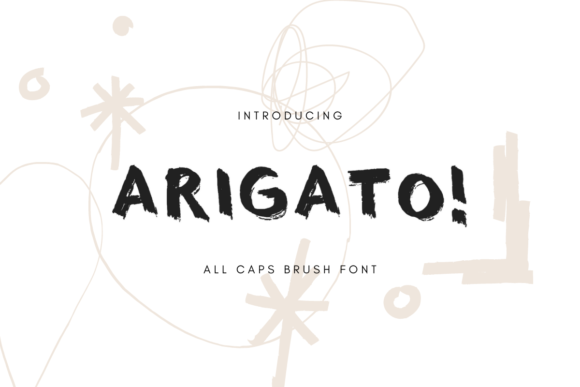
Arigato: The Bold Brushed Font That Brings Handcrafted Energy to Your Designs
There is a specific kind of energy that only a brushed typeface can convey. It feels immediate, human, and slightly imperfect in the best possible way. Arigato captures this spirit perfectly. As a bold and brushed display font, it stands out not just because of its thickness, but because of the texture and movement inherent in every letterform. When you are looking to inject a sense of craft and originality into a project, this typeface offers a powerful visual voice that standard sans-serifs simply cannot match.
The name itself, meaning "thank you" in Japanese, hints at the warm, appreciative vibe the font often brings to a layout. However, its application goes far beyond greeting cards. Because of its strong, original look, Arigato appeals to a wide range of crafty ideas, serving as a versatile tool for designers, small business owners, and creatives who need their work to feel personal yet professional.
Bringing Personality to Brand Identity
One of the most compelling uses for Arigato is in brand identity, particularly for businesses that want to distance themselves from the sterile, corporate aesthetic. Imagine a local coffee roaster or an artisanal bakery. These brands thrive on the idea of human touch and craftsmanship. Using a clean, geometric font might make them look efficient, but it won't make them feel warm.
When applied to a logo or a primary headline, Arigato's brushed strokes mimic the mark of a paintbrush or a marker, suggesting that something was made by hand. This psychological cue is powerful. It tells the customer, "We care about the details," before they even read the rest of the text. For stationery suites, such as letterheads and business cards, this font creates an instant impression of creativity. A consultant or a freelance designer using Arigato on their letterhead signals that they think outside the box, distinguishing themselves from competitors who rely on safe, overused typography.
Ideal Industries for Brushed Typography
While the font is versatile, it shines brightest in specific sectors where emotion and aesthetics drive purchasing decisions. Consider these scenarios:
- Fashion and Apparel: T-shirt designs and hoodie graphics benefit immensely from the bold weight of Arigato. The brush texture adds depth to screen printing, making the design look less like a digital file and more like street art.
- Food and Beverage: From craft beer labels to gourmet food truck menus, the font conveys a sense of robust flavor and authentic ingredients.
- Event Planning: Weddings, music festivals, and pop-up markets often require titles that feel celebratory and energetic. Arigato provides that festive punch without looking childish.
- Creative Services: Photographers, illustrators, and interior designers can use it in portfolio headers to frame their work with a similar artistic flair.
Practical Applications in Stationery and Print
The prompt mentions stationery, and rightly so. There is a tangible satisfaction in holding a piece of paper that feels designed with intention. Arigato excels here because its bold nature ensures readability even when printed on textured stock. If you are designing invitations for a gallery opening or a workshop, using this font for the main title draws the eye immediately.
However, practical application requires a bit of strategy. Because Arigato is a display font, it is designed to be used at larger sizes. It is not intended for body copy or long paragraphs. Trying to force it into small print will result in legibility issues, as the brushed details may blur together or disappear entirely. The sweet spot for Arigato is in titles, subheaders, and short, impactful phrases. Think of it as the spotlight operator in your design; it highlights the most important information while letting other, simpler fonts handle the heavy lifting of detailed reading.
Navigating Limitations and Pairing Strategies
No font is a magic bullet, and understanding the limitations of Arigato is key to using it effectively. Its greatest strength—its bold, textured character—is also its potential weakness if overused. A page filled entirely with brushed text can feel chaotic and exhausting to the eye. The noise of the brush strokes competes for attention, leaving the viewer with no place to rest.
To counter this, successful designers pair Arigato with neutral, clean counterparts. A crisp sans-serif like Helvetica or a simple geometric font works beautifully underneath or alongside it. This contrast allows the personality of Arigato to pop while maintaining a structured, readable layout. For example, on a poster, you might use Arigato for the event name in massive letters, while using a thin, clean sans-serif for the date, time, and location details. This hierarchy guides the reader naturally through the information.
Another consideration is color. While black on white is classic, brushed fonts often come alive when color is introduced. Because the strokes have variation in thickness, gradients or textured backgrounds can interact with the letters in interesting ways. However, ensure there is enough contrast between the font color and the background. The irregular edges of the brush style can get lost against busy patterns, so a solid or subtly textured background is usually the safest bet for clarity.
Why It Resonates with Modern Audiences
In a digital world saturated with perfect, vector-sharp lines, there is a growing hunger for imperfection. Adults aged 20 to 50, who make up the core of the creative consumer base, often seek products and services that feel authentic. They are tired of generic templates. Arigato taps into this desire for authenticity. It feels like it was created in a studio, not generated by an algorithm.
This resonance extends to social media graphics as well. An Instagram story highlight cover or a YouTube thumbnail using Arigato stands out in a feed full of uniform content. It stops the scroll because it looks different. It suggests that the content behind the image is equally unique and worth exploring. For content creators, this font is a tool for branding consistency; using it across different platforms creates a recognizable visual signature.
Making the Right Choice for Your Project
Before committing to Arigato for a major project, ask yourself what emotion you are trying to evoke. If the goal is trust, stability, and traditional corporate reliability, a serif or a standard sans-serif might be safer. But if the goal is excitement, creativity, approachability, and a hint of rebellion, Arigato is an excellent choice.
It is also worth testing the font in the actual medium it will be used. Screen rendering and print rendering can differ. On a website, ensure the font file loads quickly and remains crisp on high-resolution displays. In print, request a proof to see how the ink interacts with the paper stock. Some porous papers might absorb the fine details of the brush strokes, softening the look, which can be a desirable effect or a dealbreaker depending on your vision.
Ultimately, Arigato is more than just a set of characters; it is a stylistic statement. Whether you are crafting a letterhead that needs to impress a potential client, designing a title sequence for a video, or creating signage for a local shop, this font provides the boldness and character needed to make a lasting impression. By respecting its nature as a display piece and pairing it thoughtfully, you can unlock its full potential to transform ordinary designs into something memorable and distinctly human.